

The Real Problem: Networks Grow Faster Than the Spreadsheets That Track Them
Network management has always been a balancing act. The infrastructure grows, devices change hands, DHCP scopes shift, reserved addresses get reassigned, and someone still has to know which IP belongs where. In too many organizations, that knowledge lives in a spreadsheet, a shared folder, or the memory of one overworked engineer.
That approach works right up until it doesn’t.
The issue is not just administrative inconvenience. It is operational risk. When IP data is scattered, teams lose time chasing down conflicts, duplicate assignments, abandoned subnets, and unclear ownership. Troubleshooting slows down. Audits become painful. Even basic planning gets harder because no one can trust the source of truth.
This is why IPAM solutions have moved from “nice to have” to strategically important. They are not just about keeping a cleaner address table. They are about reducing friction across the entire network management process. In practice, they help teams move from reactive cleanup to controlled, deliberate network operations.
Lumics fits neatly into that reality. Its monitoring platform already gives engineers a fast, practical view of network performance, and its IPAM module extends that visibility into address management without turning the tool into another administrative burden.
What Strong IP Address Management Actually Does
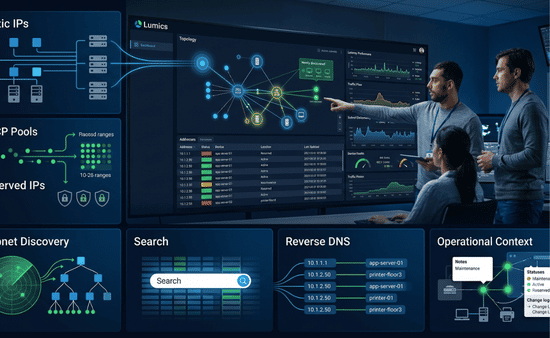
A lot of teams say they need better IP tracking. What they usually need is a system that can do three things well: give them a single view, keep that view current, and make it easy to act on the data.
That sounds simple, but it is exactly where spreadsheet-driven processes fail. A spreadsheet can store data, but it cannot discover new subnets, validate active addresses, or help you see what has changed since the last manual update.
A strong IPAM workflow should support:
- Static IP tracking for fixed infrastructure
- DHCP visibility for dynamic address pools
- Reserved address management for controlled exceptions
- Subnet discovery across the network
- Search, sorting, and filtering at scale
- Reverse DNS lookup for faster identification
- Notes and status fields that reflect operational context
When those capabilities are combined, the result is not just a cleaner record. It is a working control layer for the network. That matters because address management sits right at the intersection of operations, troubleshooting, and planning. If the data is weak, everything built on top of it becomes slower and less reliable.
Lumics handles this in a way that aligns with how engineers actually work. Rather than asking teams to bolt on another isolated system, it incorporates core IP Address Management functionality in the base platform. That design choice matters because it keeps address visibility connected to the same monitoring environment used to understand performance and behavior.
Why This Is More Than an Inventory Problem
The deepest mistake teams make is treating IP management as a clerical task. It is not. It is a live operational function.
An unknown IP can delay troubleshooting. A stale record can lead to confusion during an outage. A misfiled subnet can cause planning errors when new infrastructure is added. Once address data gets disconnected from the network itself, the organization ends up managing symptoms instead of systems.
That is the strategic value of modern IPAM solutions: they create reliable context. Not just “what IP is this,” but “where does it belong, is it active, and how does it fit into the rest of the environment?”
Why Integrated IPAM Changes the Economics of Network Management

Most teams do not struggle because they lack tools. They struggle because they have too many disconnected ones. A standalone address manager may solve one problem, but it can also create another layer of licensing, logins, upkeep, and process overhead.
This is where Lumics takes a more disciplined approach. Its IPAM capability is included directly in the core platform base pricing, which means organizations do not have to treat IP address management as a separate line item. That sounds like a pricing detail, but it has real operational implications.
First, it reduces friction. Teams are more likely to use a feature that is already part of the platform they trust. For another, it reduces the administrative overhead of introducing yet another tool into the stack. And because the IPAM module lives inside the same monitoring environment, the relationship between address data and network performance stays intact.
That integration matters most in three situations:
- When a team is small and time is scarce.
Engineers do not want to maintain a second system just to know which addresses are in play. - When a network is large enough to outgrow manual tracking.
Thousands of IPs are manageable only when search, filtering, and automated discovery replace hand-edited records. - When operational context matters.
Address data becomes more useful when it sits beside performance data, status information, and monitoring history.
Lumics makes that model practical. It is built for teams that want real visibility without turning their environment into a tool administration project.
The Hidden Cost of “Good Enough” Tracking
A spreadsheet may feel free, but it is rarely cheap in practice. Every manual update carries the risk of inconsistency. Every copied row can drift from reality. Every undocumented change becomes future rework.
The real cost is not software. It is engineer time. And engineer time is expensive.
That is why integrated IPAM solutions often outperform more fragmented setups. They do not just reduce tool count. They reduce decision latency. When the right information is available immediately, teams can spend less time reconciling records and more time fixing the actual issue.
What Lumics Does Differently for IP Address Visibility
The value of an IPAM module depends on how well it reflects the live network. If it requires manual reconstruction, it becomes another spreadsheet with a better interface. If it discovers, organizes, and updates addresses with minimal effort, it becomes part of the operational backbone.
Lumics is designed around that second model.
Its IPAM module supports planning, tracking, and managing static, DHCP, and reserved configurations from a centralized interface. That means users can sort, search, and filter across large address sets without piecing together separate files or silos. The practical outcome is simple: faster lookup, cleaner oversight, and less uncertainty.
It also includes automatic subnet discovery. If routers and switches are already monitored in Lumics, the system can recognize and map subnets automatically. That reduces the setup burden and removes one of the most tedious parts of address management: building the inventory before you can even begin using it.
Subnet Discovery That Starts from the Network You Already Know
A lot of IPAM projects stall at the beginning because the initial data model is too manual. Someone has to gather subnets, confirm ranges, and build the structure from scratch. That creates delay, and delay is often what kills adoption.
Lumics takes a more operationally useful approach by using existing monitored infrastructure as a starting point. If the network is already visible in the platform, the subnet picture can emerge from that visibility. That is a significant practical advantage because it reduces duplicate setup work and keeps address management tied to the actual network state.
Richer Records Without More Administrative Burden
Good IPAM is not only about listing addresses. It is about making each record useful. Lumics provides subnet tracking details such as status, DNS names, days since last response, response time, and custom organizational notes.
That combination matters because it supports both troubleshooting and planning. A record that only shows an address is informational. A record that shows responsiveness, naming, and usage context becomes operationally useful.
The module also supports reverse DNS lookup, so discovered IPs can be identified more easily. That makes it easier to move from “I see an address” to “I know what this address belongs to,” which is often the real question during an incident or audit.
How Better IPAM Supports Real Network Operations

The most effective network teams do not use IPAM as a static database. They use it as part of a broader operational loop: discover, verify, monitor, and adjust.
That is where the value becomes visible in day-to-day work.
A practical network manager might use IPAM data to:
- Validate whether an IP belongs to a static asset or a DHCP pool
- Check whether a subnet is active or stale
- Confirm that naming and DNS data match the current environment
- Identify gaps before assigning new address ranges
- Reduce troubleshooting time when a device disappears or starts responding slowly
- Spot patterns in address use across geographic or organizational groups
These are not abstract wins. They are the kinds of small efficiencies that compound into better uptime, cleaner handoffs, and less rework.
Lumics is especially relevant here because it does not treat address management as a separate universe. It sits inside a monitoring platform that already aims to give engineers instant, real-time data and graphs about network performance and business impact. That context makes the IPAM module more valuable than a standalone list ever could be.
The Long-Term Advantage: Simplicity That Holds Up Under Growth
Many tools look solid when the environment is small. Fewer survive growth without becoming cumbersome. The difference is usually whether the tool helps the team stay clear, or whether it adds another layer of process.
That is why network management strategy should favor systems that stay simple as they scale. Not simplistic, but simple in the right way: fast to understand, easy to operate, and hard to outgrow.
Lumics leans into that philosophy. Its platform is positioned for engineers who want speed, clarity, and less wasted motion. That matters because network teams do not need more ceremony. They need fewer blind spots.
If you are evaluating IPAM solutions, the real question is not whether they can store addresses. It is whether they can help your team maintain control as the network gets more complex. The better answer is a system that keeps discovery, visibility, and operational context together in one place.
That is the long-term value of thoughtful IP address management. It does not just tidy up records. It makes the network easier to run, easier to trust, and easier to scale without creating avoidable overhead. For teams that care about practical control rather than tool sprawl, Lumics makes a strong case for doing it the right way from the start.