Bridges have long served a fundamental human need: connecting communities separated by wide rivers, treacherous ocean straits, or formidable mountain valleys. Yet, in the modern era, these transit routes have evolved into something far greater than basic utility. Today’s bridges represent the peak of structural ambition, pushing the boundaries of physics, material science, and artistic expression to redefine skylines across the globe.
From gravity-defying cable-stayed structures to intricate pedestrian walkways, modern bridges showcase what is possible when visionary architectural concepts meet precision civil engineering. Let’s explore some of the world’s most impressive modern bridges and the engineering ingenuity behind them.
1. Millau Viaduct (France)
Stretching gracefully across the Tarn River Valley in southern France, the Millau Viaduct is an iconic masterpiece of cable-stayed design. Engineered by Michel Virlogeux and designed by architect Norman Foster, the bridge reaches an astonishing maximum pier height of 343 meters (1,125 feet)—making it taller than the Eiffel Tower.
Completed in 2004, its slender towers and minimal deck profile give drivers the surreal sensation of floating above the clouds. The viaduct was constructed using an innovative technique known as “incremental launching,” where prefabricated steel deck sections were built on land and systematically rolled into place across massive concrete piers. This approach minimized environmental disruption to the valley floor while creating a structure that harmonizes effortlessly with its natural surroundings.
2. Akashi Kaikyō Bridge (Japan)
Spanning the turbulent Akashi Strait between Kobe and Awaji Island, the Akashi Kaikyō Bridge—also known as the Pearl Bridge—boasts one of the longest central spans of any suspension bridge in the world, stretching nearly two kilometers.
Opened in 1998, the bridge is as much a triumph of disaster resilience as it is of structural scale. Located in a region subject to violent typhoons and severe seismic activity, engineers designed the structure to withstand severe earthquakes and extreme wind forces. The bridge incorporates complex tuned mass dampers and high-strength steel cabling that dynamically counteract environmental loads, ensuring safe, continuous travel for millions of commuters annually.
3. Sheikh Zayed Bridge (Abu Dhabi, UAE)

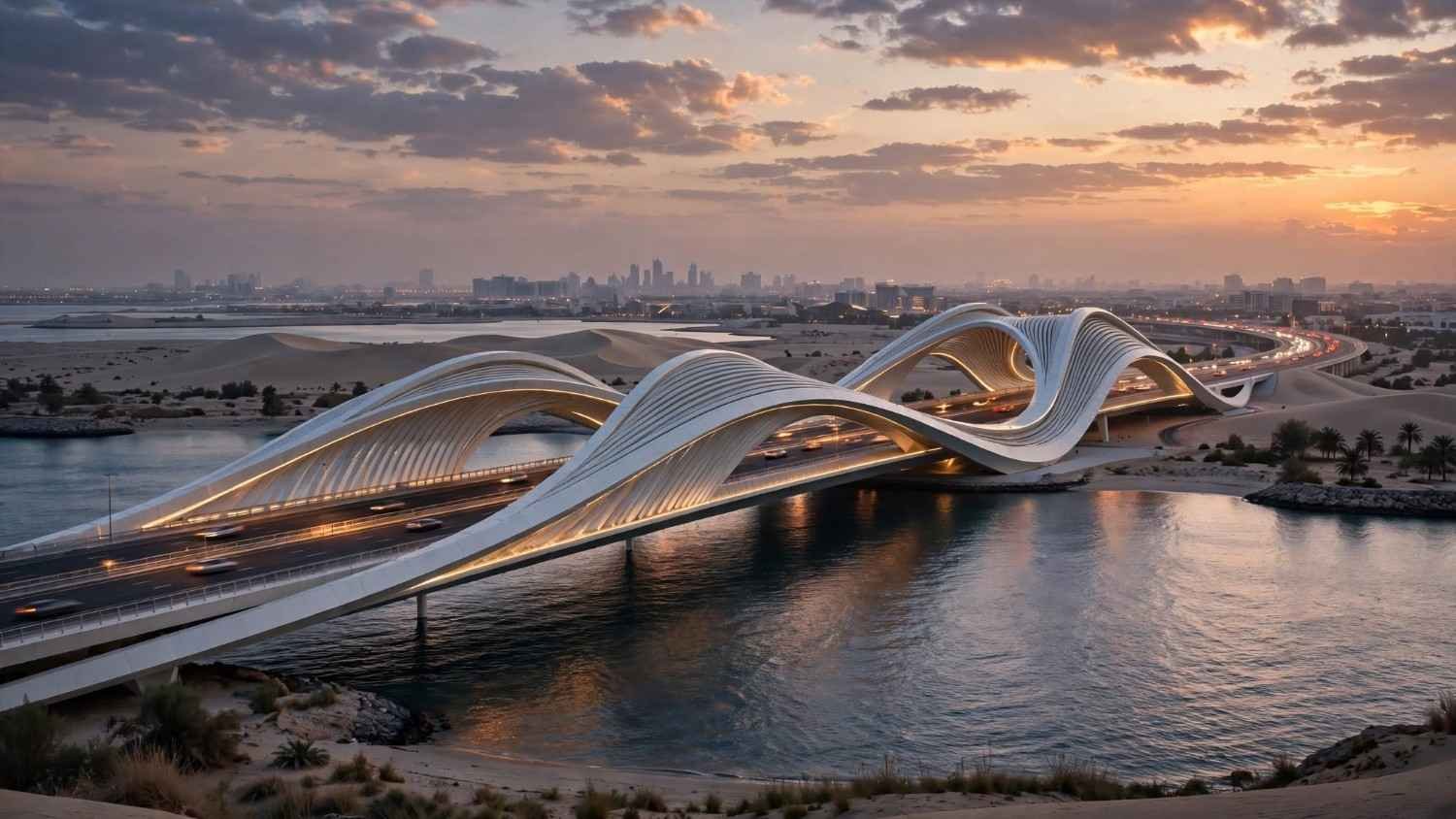
Designed by the late, legendary architect Zaha Hadid, the Sheikh Zayed Bridge in Abu Dhabi represents a striking blend of futuristic aesthetics and heavy structural engineering. Completed in 2010, the bridge features sinuous, sweeping steel arches that echo the natural fluid contours of desert sand dunes.
The 842-meter structure relies on cantilevered road decks extending outward from central arch ribs. At night, a dynamic, integrated LED lighting system illuminates the curved frame, transforming a critical highway crossing into a glowing public sculpture that celebrates the region’s cultural identity.
4. The Helix Bridge (Singapore)
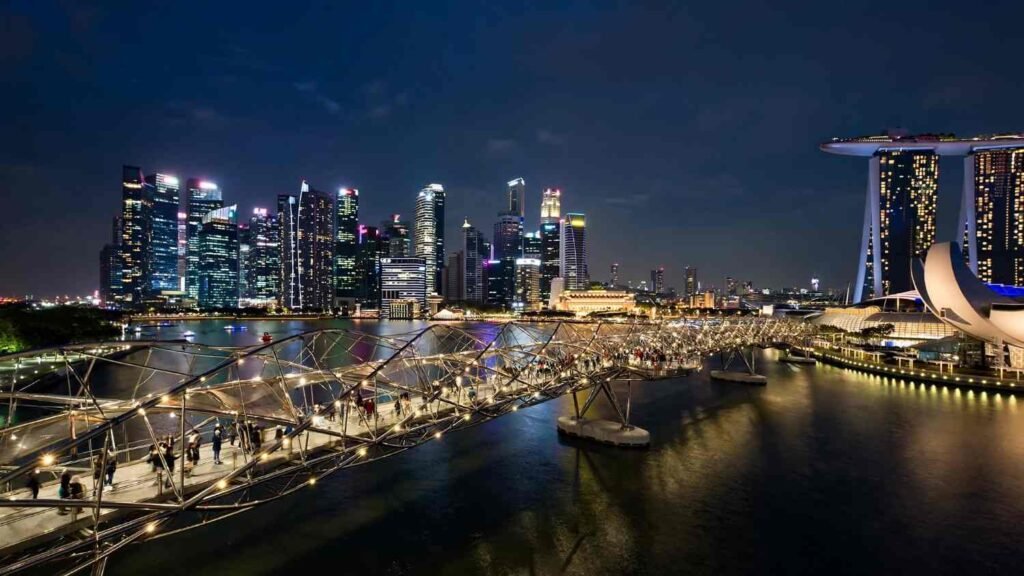
Located in Singapore’s Marina Bay, The Helix Bridge is a pedestrian crossing that redefines urban infrastructure. Opened in 2010, the bridge’s design was directly inspired by the double-helix geometry of human DNA, symbolizing connection, continuity, and growth.
The double-helix framework utilizes opposing spiral steel tubes that interact to provide high structural rigidity with lightweight visual appeal. This intricate stainless-steel assembly creates an immersive pathway for pedestrians, offering shaded observation decks and sweeping views of Singapore’s urban landscape.
5. Øresund Bridge (Denmark to Sweden)
Connecting Copenhagen, Denmark with Malmö, Sweden, the Øresund Bridge is a brilliant response to complex environmental and logistical constraints. Spanning 16 kilometers across the Øresund Strait, this hybrid infrastructure project seamlessly transitions from a high-level cable-stayed bridge to an artificial island, and finally into an underwater tunnel.
Opened in 2000, this dual-rail and highway link preserved vital maritime shipping lanes and prevented interference with air traffic near Copenhagen Airport, all while protecting delicate marine ecosystems. It remains an enduring international symbol of Scandinavian cooperation and engineering flexibility.
The Role of Advanced Materials in Modern Spans
Behind every gravity-defying span lies a foundation of modern metallurgy, computational modeling, and materials science. Contemporary bridge construction relies on high-performance concrete, advanced carbon-fiber composites, and precision steel fabrication engineered to endure immense tensile stress and fatigue.
Quality sourcing and rigorous fabrication standards are critical at every step. Whether building massive international suspension spans or executing regional infrastructure projects, securing high-grade structural components—such as sourcing reliable steel in Salt Lake City for domestic bridge builds—ensures that ambitious designs can safely withstand decades of heavy traffic, wind resistance, and extreme weather variations.
Conclusion
Modern bridges are far more than functional transportation links; they are monuments to human ambition, technical progress, and artistic expression. By combining advanced engineering methods with visionary architectural concepts, civil engineers continue to turn formidable environmental obstacles into breathtaking landmarks. Ensuring structural durability also requires attention to building materials and construction techniques, including construction quality with concrete vibrators, which highlights the importance of proper concrete consolidation in reducing air pockets and improving structural integrity.
As design capabilities expand, the bridges of tomorrow will undoubtedly continue to connect communities while pushing the boundaries of what is structurally possible.