
For three years, my morning routine consisted of reaching over my nightstand, grabbing my phone, and reading Slack messages while squinting through bleary eyes. Within ninety seconds of waking up, my heart rate spiked, my focus evaporated, and someone else’s crisis dictated my day. That bed-to-desk cycle ruined my focus and burned me out. Implementing intentional, mindful morning routine ideas for remote workers completely rescued my sanity, cut my morning dread, and rebuilt my cognitive sharpness.
A mindful routine does not require two hours of incense burning or silent contemplation. It requires biological alignment, tactical boundaries, and an operational barrier between sleep mode and work mode.
The Biological Reason Your Remote Mornings Feel Broken
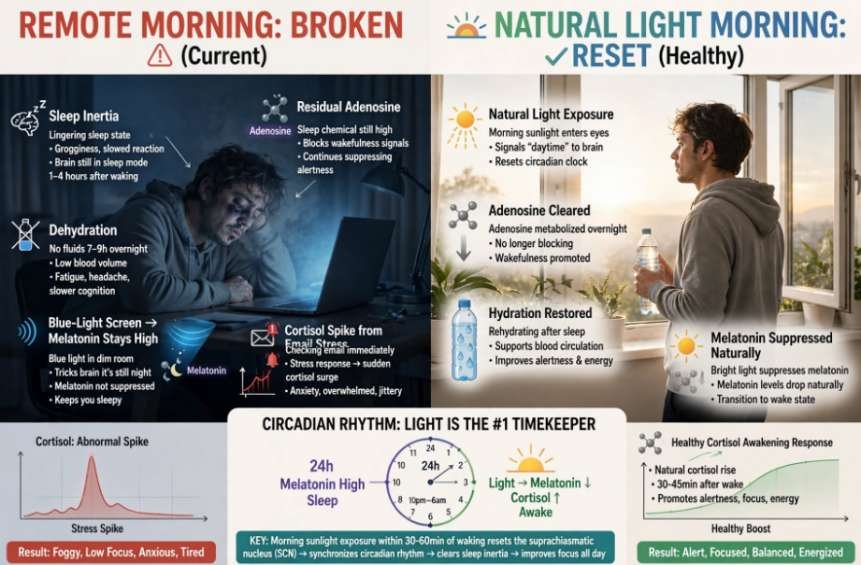
Remote workers lack the forced physical transition of an office commute. Without a train to catch or a car to drive, we strip our biology of the environmental cues that clear mental haze.
Breaking Sleep Inertia with Lux and Hydration
When you wake up, your body sits in sleep inertia. According to the Sleep Foundation, this groggy state stems from residual adenosine in your brain tissue, coupled with overnight dehydration and a lower core body temperature.
Reaching straight for a mug of black coffee masks the underlying issue. Your brain is slightly contracted from seven hours without fluids, and your melatonin production remains active until bright light enters your eyes. The CDC highlights how natural light exposure sets human circadian rhythms and halts melatonin synthesis. If you sit in a dimly lit home office staring at a blue-light screen, your brain remains biochemically asleep.
Why Immediate Email Access Spikes Cortisol
Opening your email inbox within thirty minutes of waking triggers an artificial panic response. Research shared by the Harvard Business Review emphasizes that checking messages first thing forces your brain into a reactive posture, driving up stress hormones and destroying high-level strategic reasoning.
When you read a client grievance or a manager’s urgent ping before you have even brushed your teeth, your sympathetic nervous system takes over. You sacrifice your highest cognitive window of the day to satisfy incoming requests that could easily wait ninety minutes.
Relying on mindset alone to manage ongoing work pressure can also contribute to exhaustion, which is why understanding how mindset alone can lead to burnout is important when building healthier work habits.
The 4-Stage Mindful Morning Blueprint That Transformed My WFH Life
To break this pattern, I engineered a chronological sequence that addresses physical alertness first, deep work second, and external communication last.
+——————————————————-+
| 07:30 – 07:45 AM | Stage 1: Physiological Flush |
| 07:45 – 08:15 AM | Stage 2: The “Fake Commute” |
| 08:15 – 09:45 AM | Stage 3: Deep Focus Anchor |
| 09:45 – 10:15 AM | Stage 4: 4D Inbox Batching |
+——————————————————-+
Stage 1: The 15-Minute Physiological Flush

My alarm sounds at 7:30 AM, and my phone remains docked across the room in my hallway. I get out of bed immediately to silence it, eliminating the option to scroll.
- 500 ml Water Intake: I drink a full pint of room-temperature water before touching anything else. This rehydrates brain cells and activates gastric motility.
- Lux Loading: I walk directly to my balcony or front porch. I spend seven minutes looking toward the natural sky without sunglasses. Direct sunlight suppresses residual melatonin and initiates a healthy morning cortisol peak.
- Thermal Reset: I head to the bathroom and wash my face with freezing water for thirty seconds. The rapid temperature drop triggers a gentle adrenaline release that instantly dissolves eye heaviness.
Stage 2: The Screen-Free “Fake Commute”

The biggest mistake remote professionals make is rolling directly from under the duvet into an office chair. A fake commute establishes psychological distance between personal recovery and professional output.
Between 7:45 AM and 8:15 AM, screens remain strictly off. I slip on athletic shoes and walk a brisk loop around my neighborhood. Physical movement raises core body temperature, expands lung capacity, and pumps fresh oxygen to the prefrontal cortex.
When I return indoors, I change out of lounge clothes into clean, comfortable casual wear. Changing your clothes signals an identity shift: you are no longer resting; you are preparing to create value. If you regularly struggle with digital burnout during this period, plan to do a digital detox over the weekend to reset your baseline attention span and lower baseline anxiety.
Stage 3: The 90-Minute Caffeine and Focus Anchor

At 8:15 AM, I sit at my desk, but I do not open Slack, Teams, or Gmail. This practice is called delayed decoupling.
I make my first cup of coffee now—roughly forty-five to sixty minutes after waking. Delaying caffeine allows my body to naturally flush out adenosine rather than temporarily masking it. As a result, I avoid the dreaded 11:00 AM energy crash entirely.
Next, I complete my three-minute alignment on a physical notepad:
- The Prime Anchor: What single deliverable moves my core project forward today?
- The Boundary: What non-urgent meeting or conversation will I decline or postpone?
- The Emotional Tone: What mindset do I want to project during team syncs?
From 8:30 AM until 9:45 AM, I dedicate myself entirely to that single core deliverable. My laptop Wi-Fi stays disconnected if the task allows it. Working on your most complex problem before opening your inbox gives you an unshakeable feeling of accomplishment.
Stage 4: Strict 4D Communication Batching
At 9:45 AM, having already completed my hardest task, I open my email client for the first of three daily batching windows. Managing email mindfully means handling messages as logistics, not emergencies.
I execute the 4D method on every incoming thread:
| Decision | Application Rule | Action Taken |
| Delete | Cold outreach, informational notices, outdated threads | Archive or delete immediately to minimize visual noise. |
| Delegate | Inquiries that sit outside my primary project scope | Forward directly to the appropriate owner with brief context. |
| Do | Clear questions requiring less than two minutes of effort | Type a concise response and resolve the thread immediately. |
| Defer | Complex requests requiring deep research or approvals | Move to an “Action Needed” folder and schedule for the afternoon. |
By 10:15 AM, my inbox is empty, my top priority is finished, and my stress remains completely under control.
Designing a Low-Friction Workspace Sanctuary
Physical chaos creates cognitive chaos. Your brain constantly registers incomplete items in your visual periphery, subtly draining your executive function.
Every evening, I spend two minutes wiping down my desk surface, placing my pen parallel to my notebook, and sliding my chair in. When I walk into my workspace at 8:15 AM, there is no clutter demanding my attention. Keep only the tools required for your immediate morning task on your desk. Everything else belongs in drawers or separate rooms.
Clock Out of the Bed-to-Desk Trap
Reclaiming your morning is not about squeezing more output out of your workday; it is about protecting your peace of mind before the rest of the world starts demanding it.
Making these small routine changes can also be part of a broader personal transformation, and exploring how to reset your life mindset may help you approach everyday habits with a more positive and intentional perspective.
Stop letting your inbox set your emotional baseline. Hydrate immediately, get outdoors for early sunlight, keep your screens closed for the first hour, and complete your most important project before you let notifications into your space. Start tomorrow morning with just one of these adjustments, and watch your mental fog disappear.
Frequently Asked Questions
1. How long should a mindful morning routine take for remote workers?
A complete, effective routine takes between 30 and 45 minutes before starting your initial focused work block.
2. When is the best time to check emails when working from home?
Check your inbox only after completing your primary morning task, ideally around 10:00 AM or 11:00 AM.
3. Why should I delay coffee after waking up?
Delaying coffee by 60 to 90 minutes prevents afternoon crashes by letting your body clear sleep-inducing adenosine naturally.
4. How do I stop checking my phone immediately in bed?
Charge your smartphone in another room overnight and use an inexpensive standalone alarm clock on your nightstand instead.