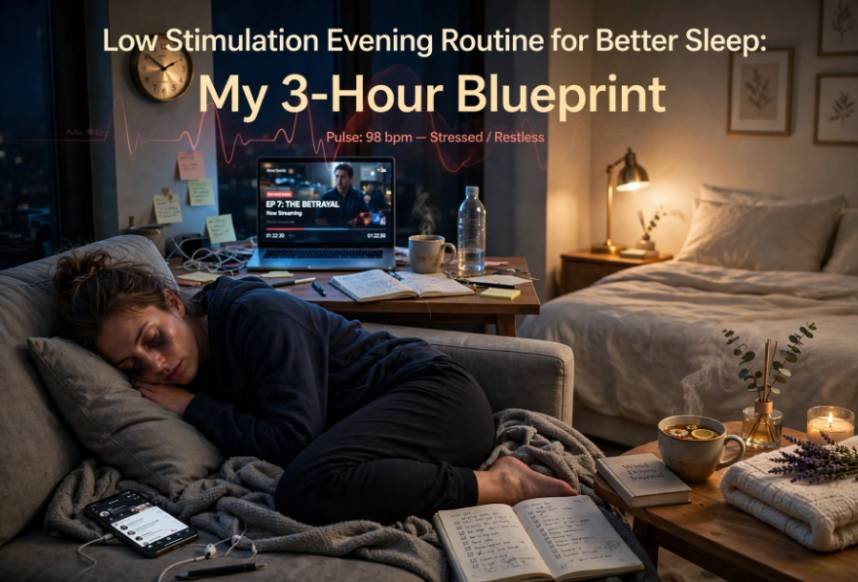
My sleep used to be a nightly battle against my own racing pulse. I would collapse onto the sofa after ten hours at my desk, binge television dramas, scroll social feeds, and wonder why I tossed and turned until 2:00 AM. Building a structured low stimulation evening routine for better sleep changed that entire trajectory, reducing my sleep latency from 42 minutes to under 15 minutes.
Real rest does not happen when you flip a light switch. Your nervous system demands a slow ramp-down to transition safely from sympathetic survival mode into parasympathetic repair.
The Biology Behind Evening Sensory Overload
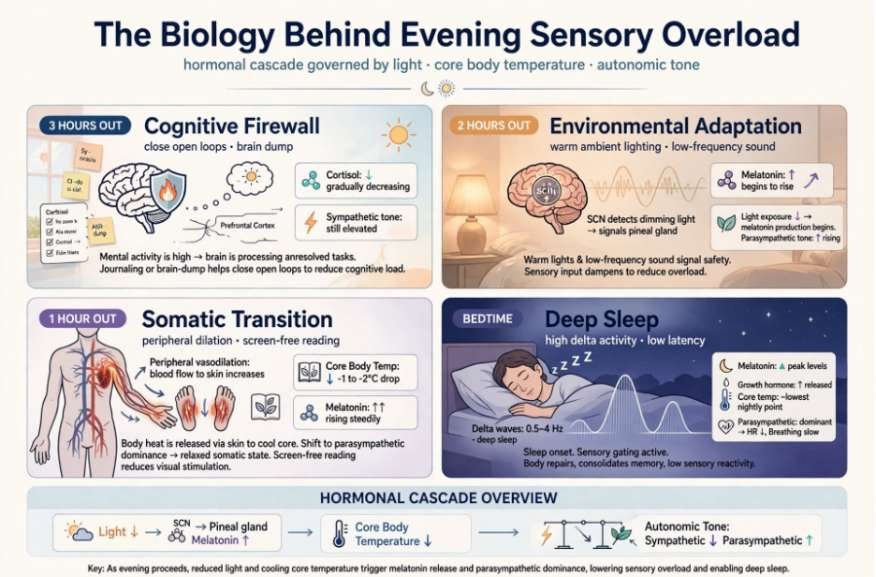
Sleep onset is a hormonal cascade governed by light, core body temperature, and autonomic tone. When you bombard your senses with rapid visual stimulation, loud audio, and cognitive demands right up to bedtime, you delay the onset of sleep.
3 Hours Out 2 Hours Out 1 Hour Out Bedtime
┌─────────────────────────┐┌─────────────────────────┐┌─────────────────────────┐┌──────────────┐
│ Cognitive Firewall ││ Environmental Adaptation││ Somatic Transition ││ Deep Sleep │
│ • Close open loops ││ • Warm ambient lighting ││ • Peripheral dilation ││ • High delta │
│ • 5-minute brain dump ││ • Low-frequency sound ││ • Screen-free reading ││ activity │
│ • Lock down devices ││ • Limbic diffuser scent ││ • Core temperature drop ││ • Low latency│
└─────────────────────────┘└─────────────────────────┘└─────────────────────────┘└──────────────┘
Why Modern Downtime Secretly Spikes Cortisol
Most people confuse being sedentary with being relaxed. Watching high-stakes thrillers or scrolling through news feeds requires continuous cognitive processing and micro-emotional reactions.
Studies indexed by the National Center for Biotechnology Information reveal that short-wavelength blue light directly suppresses pineal melatonin secretion. More importantly, high-frequency visual frame changes trigger subtle dopamine bursts that delay sleep latency. You might sit still on your sofa, but your brain remains on high alert.
The Thermoregulation Trigger You Are Missing
Natural sleepiness coincides with a steep fall in core body temperature. In humans, this internal drop ranges between 1 to 2 degrees Fahrenheit.
According to research highlighted by the Sleep Foundation, dilating peripheral blood vessels in your hands and feet accelerates heat dissipation from your core. If your room is hot, or if you exercise vigorously late at night, your core temperature stays elevated. This thermal barrier prevents you from shifting into deeper sleep cycles.
The 3-Hour Decompression Timeline I Swear By
I organize my evenings into three distinct one-hour segments. Each hour strips away another layer of mental and physical stimulation.
Hour 1: The Cognitive Wind-Down and Working Memory Clear
Three hours before bed, I shut my laptop and terminate problem-solving mode. Lingering tasks create cognitive friction that sparks nighttime awakenings.
I spend five minutes running a physical brain dump on a notepad. I list every unaddressed email, tomorrow’s primary deliverable, and personal errands. Writing them down on paper closes these open mental loops.
If runaway thoughts still cloud your evening, learning how to stop overthinking and anxiety through proactive cognitive offloading will instantly free your mind. Next, I switch my phone to sleep focus mode to block incoming alerts.
Hour 2: Environmental Adaptation and Acoustic Flooring
Two hours before bed, I reconfigure my physical environment. I turn off all cool white overhead lighting across my apartment.
I switch exclusively to low-wattage, warm amber lamps positioned below eye level. Mimicking the warm spectrum of sunset signals your suprachiasmatic nucleus that night has arrived.
I also cut out jarring background sounds. City traffic, television dialogue, and kitchen appliances keep auditory sensory gating active. I replace them with continuous soundscapes to stabilize the acoustic environment.
Hour 3: The Somatic Transition and Thermal Reset
The final hour belongs entirely to physical deceleration. I take a hot shower for 10 minutes roughly 60 to 90 minutes before tucking in.
Stepping out of the warm water into a cool bathroom produces rapid peripheral vasodilation. Blood rushes to your extremities, dumping heat out of your core and mimicking the natural circadian temperature drop.
After drying off, I complete my nighttime skincare routine in slow, quiet silence. I spend the remaining 30 minutes reading physical fiction under warm reading lights. No digital screens, no notifications, and zero work discussions enter this space.
Fine-Tuning the Sensory Cues: Diffusers and Acoustic Slopes
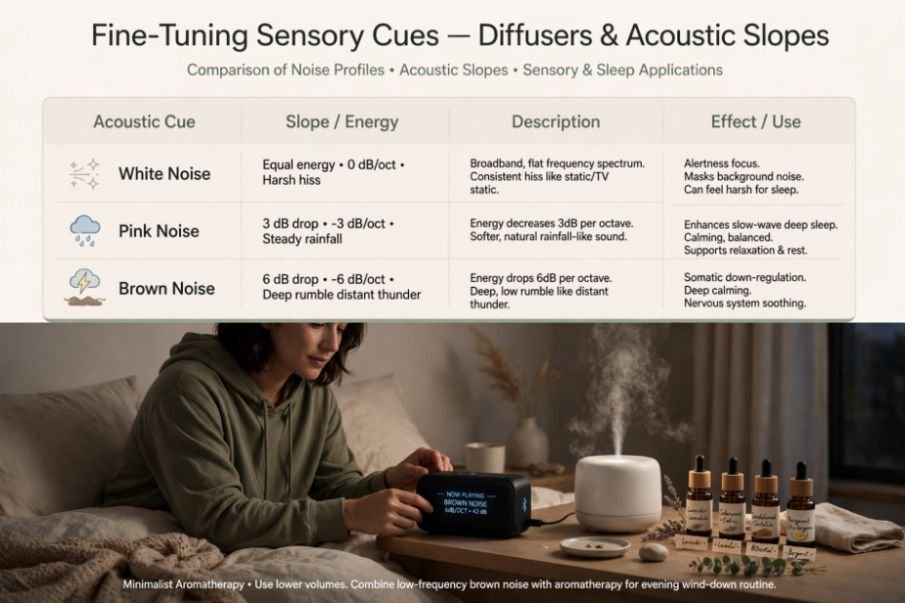
Sensory cues bypass analytical thinking. By using targeted acoustics and specific essential oil blends, you condition your brain to associate subtle inputs with physiological rest.
Sound Masking: Why I Ditched White Noise for Brown and Pink
White noise distributes energy equally across all frequencies, which sounds like harsh television static to human ears. Because our ears are sensitive to higher frequencies, white noise often produces subconscious agitation.
| Audio Type | Spectral Slope | Perceived Sound | Primary Sleep Benefit |
| White Noise | Equal energy across bands (0dB/octave) | Harsh hiss, television static | General acoustic masking in noisy urban environments |
| Pink Noise | Energy drops 3dB per octave (1/f) | Steady rainfall, rustling leaves | Enhances slow-wave deep sleep and memory consolidation |
| Brown Noise | Energy drops 6dB per octave (1/f2) | Deep rumble, distant thunder, low waterfall | Rapid somatic down-regulation and nervous tension relief |
I play brown noise through an external room speaker during my wind-down period to silence distracting auditory triggers. Research published in Frontiers in Human Neuroscience shows that lower-frequency noise distributions stabilize sleep stages far better than harsh, high-frequency white noise.
Overnight, I transition the room audio to pink noise, which synchronizes smoothly with restorative delta brain waves.
Minimalist Aromatherapy for Nervous System Regulation
Inhaled terpenes stimulate the olfactory bulb, sending immediate relaxing signals to the amygdala and autonomic system. I set an ultrasonic diffuser on my nightstand thirty minutes before bed with simple, evidence-backed combinations:
- Classic Grounding: Four drops of lavender oil and three drops of cedarwood oil reduce resting heart rate.
- Forest Rest: Three drops of sandalwood oil and two drops of bergamot oil quiet baseline mental chatter.
- Somatic Release: Four drops of Roman chamomile oil combined with two drops of sweet orange oil ease muscle tension.
The Evening Habits That Ruined My Sleep Architecture

Before perfecting this low-stimulation routine, my nightly habits continually derailed my deep sleep metrics:
- The Late-Night Workout Trap: Sweating through high-intensity interval training at 8:00 PM kept my core body temperature elevated well past midnight.
- The “Relaxing” Revenge Bedtime Procrastination: Scrolling social media in bed felt like freedom after long days, but blue light exposure wrecked my REM latency.
- Digestive Load: Eating heavy, carbohydrate-dense meals within two hours of bed caused overnight heart rate spikes and fragmented rest.
- Digital Over-Reliance: Falling asleep with tablets on my chest disrupted sleep architecture through intermittent screen flickers.
If you struggle to break the habit of constant late-night screen time, make a conscious effort to do a digital detox over the weekend to recalibrate your baseline dopamine receptors.
Clock Out Clean: Reclaim Your Nights
Deep sleep is earned through the behavioral choices you make three hours before your head hits the pillow. You do not need to overhaul your entire lifestyle tonight.
Start by dimming your overhead lights two hours before bedtime and replacing harsh television shows with a physical book. Protecting your nervous system from sensory overload is the single best investment you can make for your waking hours.
Just as a calming evening routine prepares your body for rest, incorporating mindful morning routine ideas for remote workers can help you begin the next day with greater focus, balance, and intention.
Frequently Asked Questions
1. How long does a low-stimulation routine take to show results?
Most people experience measurable improvements in sleep latency and morning mental clarity within three to five consistent nights.
2. What should I do if my mind races as soon as lights go out?
Get out of bed, sit in dim lighting, and write your thoughts on paper until drowsiness returns naturally.
3. Can I listen to podcasts during a low-stimulation routine?
Opt for low-tempo audiobooks or sleep soundscapes, as conversational podcasts often trigger active cognitive evaluation and alertness.
4. Is reading on an e-reader acceptable before bed?
Use a front-lit e-ink display on its warmest amber setting with brightness kept under 15 percent, or stick to physical paper.