My brain used to run forty tabs simultaneously, and thirty-nine of them were screaming about worst-case scenarios. I spent years trapped in paralysis, convinced that out-thinking my worry would somehow cure it. It never did. Overcoming that loop required adopting specific micro habits to stop overthinking and anxiety that bypass cognitive debate entirely.
When worry hijacks your prefrontal cortex, talking yourself out of panic feels impossible. Real relief came only when I stopped negotiating with catastrophic thoughts and started using low-friction behavioral cues to reset my physiology.
The Neural Trap: Why Traditional Mindfulness Failed My Racing Mind
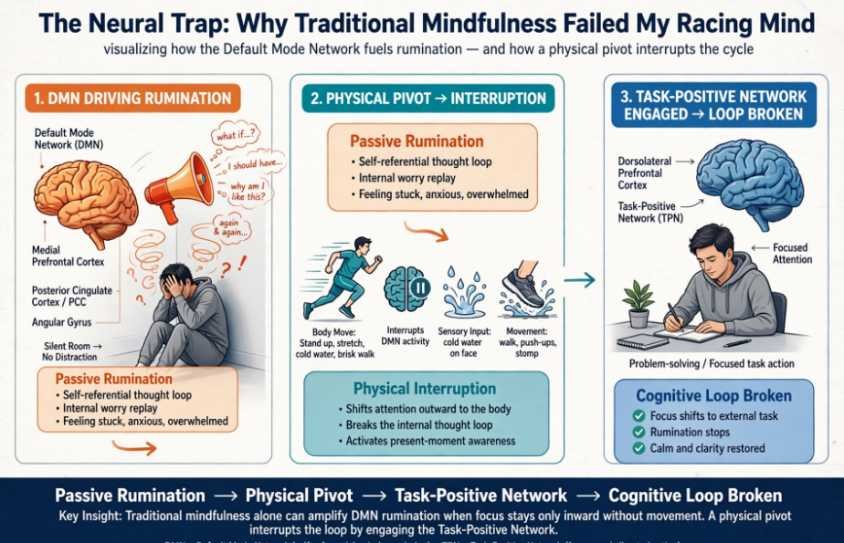
Whenever an anxious spiral hit, generic advice told me to sit quietly, close my eyes, and observe my breath. In reality, sitting motionless in a silent room handed my anxious brain a megaphone.
Neuroimaging research hosted by the National Institutes of Health highlights how our default mode network (DMN) drives self-referential thought and rumination. When an overactive mind lacks an external focal anchor, the DMN surges into overdrive. My brain translated passive meditation into unstructured space for catastrophe planning.
Breaking the Default Mode Network with Somatic Shock
I had to suppress that loop through physical interruption rather than mental debate. Shifting your autonomic state requires demanding raw sensory inputs.
Passive Rumination (DMN Active)
│
▼
Physical Pivot
(Cold water / Muscle flex)
│
▼
Task-Positive Network Takes Over
│
▼
Cognitive Loop Broken
When you activate motor pathways, your brain suppresses internal rumination to process real-time incoming physical stimuli. You break the feedback loop at the nervous system level before it cascades into dread.
Somatic Micro Habits That Interrupt Cognitive Spirals Instantly
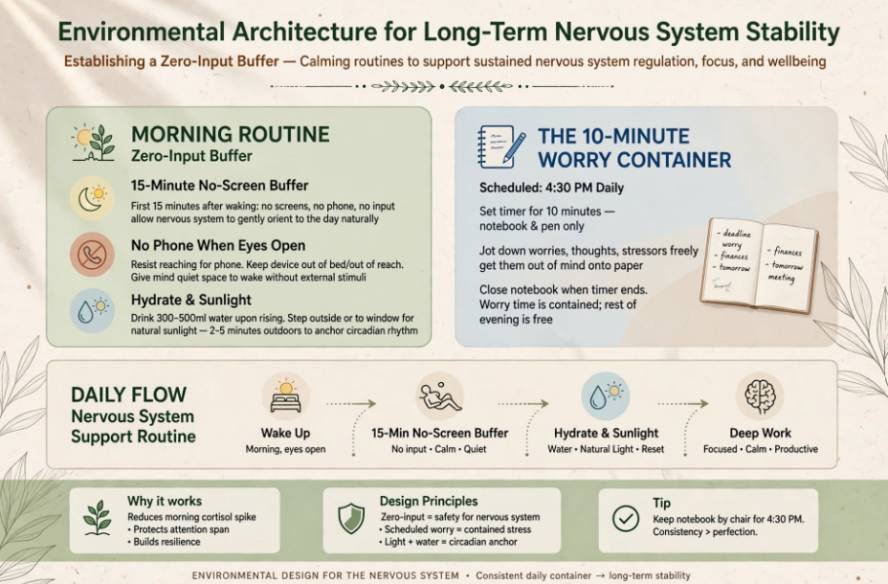
These two physical resets pull me back to reality whenever future-tripping hijacks my day.
The 5-Second Tactile Pivot
Action must precede cognitive clarity. Whenever I notice my thoughts looping around a catastrophic “what-if,” I do not reason with the narrative. I count down 5-4-3-2-1 and forcefully change my physical state.
I stand up immediately, walk to the sink, and run icy water directly over both wrists. As Harvard Health Publishing details in its coverage of the mammalian dive reflex, cold water stimulation triggers the parasympathetic nervous system, slowing down a runaway pulse. It acts as an instant neurochemical brake.
Divergent Sensory Anchoring
Most people try grounding by passively scanning the room. That leaves too much working memory available for worry.
Instead, pick up a single physical object nearby—a metal pen, a ceramic mug, or a desk key. Force your brain to identify three hyper-specific parameters:
- The exact thermal transition where the material meets room temperature.
- The micro-abrasions along its textured edges.
- Its precise physical weight resting against your fingers.
Occupying your sensory cortex with granular physical inputs leaves no cognitive bandwidth for hypothetical panic.
Daily Operating Systems to Prevent Decision Fatigue
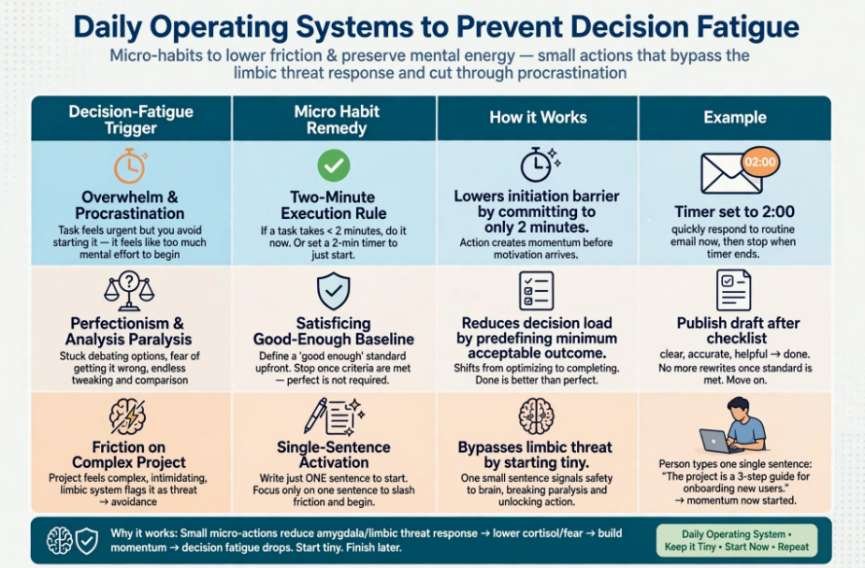
Overthinking rarely strikes out of nowhere; it feeds on the exhaust fumes of accumulated micro-decisions.
| Decision-Fatigue Trigger | The Micro Habit Remedy | Friction Shift |
| Staring at an overflowing inbox | Two-Minute Execution Rule | Eliminates open cognitive loops |
| Obsessing over output quality | “Satisficing” (Good-Enough Baseline) | Cuts perfectionism-driven dread |
| Freezing before complex projects | Single-Sentence Activation | Bypasses initial limbic threat |
Radical “Satisficing” on Low-Stakes Choices
Perfectionism is anxiety wearing a suit. Early in my career, drafting an update email devoured forty-five minutes because I re-read every sentence four times.
I cured this by deliberately adopting “satisficing”—a decision-making strategy prioritizing adequacy over perfection. Set a timer for two minutes for any routine task. Draft it once, review it once for basic clarity, and send it. Choosing “good enough” on minor details preserves critical cognitive capacity for complex priorities.
The Micro-Step Friction Slash
Large, ambiguous tasks trigger our threat-detection circuitry. When my desk queue paralyzed me, writing “finish the client report” felt like scaling a sheer cliff face.
I shrank my threshold to the absolute smallest physical action. I do not sit down to draft a twenty-page brief; I sit down to type one single sentence. Lowering the activation threshold tricks the brain past its resistance response. Once momentum takes over, execution replaces rumination.
Environmental Architecture for Long-Term Nervous System Stability
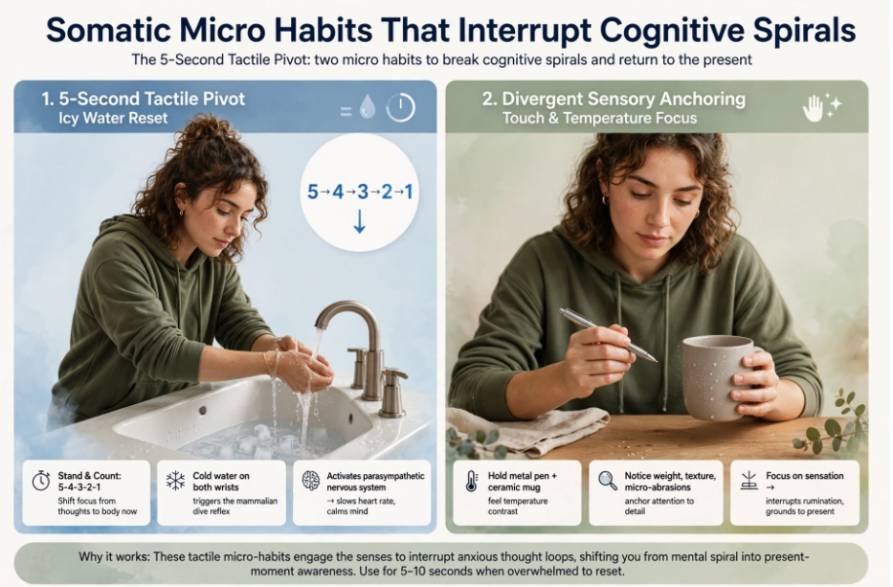
A cluttered sensory environment will dismantle your progress no matter how disciplined your mental habits are.
Establishing a Zero-Input Buffer
Reaching for your phone the moment your eyes open introduces immediate nervous system volatility. You begin the morning reacting to demands, headlines, and notifications before your feet touch the floor.
I safeguard a strict fifteen-minute zero-screen buffer every morning. No messages, no news, no feeds. Spending those opening minutes checking off simple mindful morning routine ideas lets your brain transition naturally through alpha brainwave states instead of triggering immediate adrenaline spikes.
When the workweek ends, step back further and do a digital detox over the weekend to prevent deep neurological burnout.
Wake Up ──> 15-Minute No-Screen Buffer ──> Hydrate & Sunlight ──> Deep Work
The 10-Minute Worry Container
Banning negative thoughts entirely leads to rebound anxiety.
When negative thinking and emotional exhaustion become recurring patterns, recognizing the signs you need a deep reset can help you understand when your usual coping strategies may no longer be enough.
Cognitive suppression fails because the brain flags suppressed thoughts as unresolved emergencies.
The American Psychological Association supports stimulus control therapy to manage chronic worry. I schedule a deliberate, ten-minute “worry window” every day at 4:30 PM.
Whenever catastrophic thinking strikes at 11:00 AM, I jot the topic down in a notebook and tell myself: I will process that at 4:30 PM. When the timer rings in the afternoon, I review the list. Eighty percent of the concerns have already lost their emotional grip. The remaining twenty percent get broken down into immediate, concrete action steps.
Frequently Asked Questions
1. How quickly do micro habits stop an active anxiety spiral?
Physical micro habits interrupt autonomic panic responses within sixty to ninety seconds by shifting focus to raw sensory inputs.
2. Can micro habits cure chronic anxiety disorders?
Micro habits regulate immediate symptoms and daily friction, though clinical conditions often require targeted therapy alongside daily routines.
3. What is the easiest micro habit to start with today?
The five-second physical pivot delivers the fastest relief because changing your posture requires zero prior preparation.
4. Why does overthinking get worse late at night?
Mental fatigue depletes your prefrontal cortex, leaving your threat-sensitive amygdala unchecked against lingering worries.
Stop Analyzing the Fire and Just Step Outside
Overthinking tricks you into believing that mental rumination equals practical problem-solving. It is not. Worry is passive paralysis masquerading as preparation.
Do not try to overhaul your entire lifestyle today. Pick one single behavioral interrupt—the cold water plunge or the fifteen-minute morning screen embargo. Build that physical anchor until your nervous system trusts it, and let small, decisive actions rescue you from the quiet tyranny of your own mind.